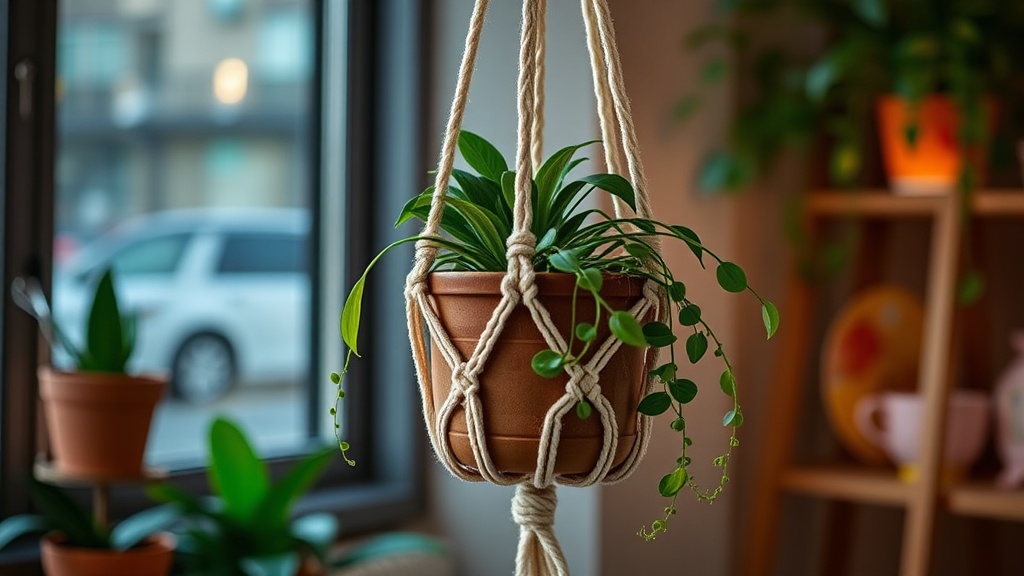
How to Make a Macramé Plant Hanger for Beginners

This post walks through a simple four-strand macramé plant hanger that suspends from a single wooden ring. In about an hour, you'll transform basic cotton cord into a functional piece of bohemian decor — no previous knot-tying experience required. The project costs roughly $12 to $15 in materials (far less than most store-bought hangers), and the finished piece cradles anything from a 4-inch terra-cotta pot to a 6-inch ceramic planter.
What supplies do you need to make a macramé plant hanger?
You need four basic items: 3mm cotton macramé cord, a 2-inch wooden or metal ring, sharp fabric scissors, and a measuring tape. Most beginners find cotton cord the easiest material to work with — it grips itself well, holds knots securely, and frays into a soft fringe that looks intentional rather than messy. Joann carries affordable 3mm single-twist cotton cord in 100-yard skeins, which is plenty for two hangers. For the ring, a 2-inch unfinished wood craft ring (also available at Joann or Michaels) works perfectly; metal O-rings from the hardware aisle are a sturdy alternative if you prefer a modern look.
Here's the thing — cord thickness matters more than most beginners realize. A 3mm cord creates a delicate, airy basket. Jump to 5mm and the same knots produce a chunky, heavier hanger better suited for large floor pots. That said, 3mm is the sweet spot for standard houseplants. You'll also want a clipboard or a sturdy hook to anchor the ring while you work; many people hang the ring from a coat hook or cabinet pull so both hands stay free for knotting.
How long should the cords be for a simple macramé plant hanger?
For a 35-inch hanger designed to hold a 6-inch pot, cut eight cords at 120 inches each — that's ten feet per cord. It sounds like overkill, but macramé eats length fast. Between the lark's head knots at the top, the square-knot body, and the gathering knot at the bottom, you'll use more cord than intuition suggests. (Better to trim excess at the end than to come up six inches short on the final tassel.)
Measure once, then use the first cord as a template to cut the remaining seven. Consistency matters — uneven cords lead to a lopsided basket. Once all eight cords are cut, fold them in half evenly and thread the folded loop through the ring. Pull the loose ends through the loop to form eight lark's head knots. You now have sixteen working strands dangling from the ring. Give them a gentle tug to seat the knots firmly against the wood.
Step 1 — Divide into four working groups
Separate the sixteen strands into four groups of four cords each. Each group will become one "leg" of the plant hanger. Keep the groups tidy; tangled cords slow everything down. A small bulldog clip or a piece of masking tape can hold unused groups to the side while you knot the first leg.
Step 2 — Tie two rows of square knots
Each square knot uses the two outer cords as "working" cords and the two middle cords as "filler" cords. Take the left outer cord, cross it over the two filler cords and under the right outer cord. Then take the right outer cord, pass it under the filler cords and up through the loop formed by the left cord. Pull gently to form the first half of the knot. Repeat in reverse — right cord over the middle, left cord under and through — to complete one full square knot.
Tie two square knots in each group, leaving about an inch of space below the ring. Worth noting: tension is everything. Pull each knot with the same gentle pressure, or the legs will stretch unevenly and the pot will sit crooked. Don't yank — cotton cord compresses if tugged too hard, which shortens the leg unexpectedly.
Step 3 — Create the basket with alternating square knots
Now for the magic. Drop down about six inches from the first row of knots. For this second row, you'll pair the adjacent outer cords from neighboring groups. In other words, take two cords from the right side of Group 1 and two cords from the left side of Group 2, and tie one square knot. Repeat around the circle until you have four new square knots that bridge the gaps between the original groups. This simple shift connects the four separate legs into a basket shape.
Drop another six inches and repeat a third row of alternating square knots directly below the second row. For a deeper basket — say, for a heavy ceramic pot — add a fourth row. The catch? Each extra row consumes roughly two feet of cord per strand, so budget accordingly. After the final basket row, gather the cords back into their original four groups.
Step 4 — Finish with a gathering knot and fringe
Slide all sixteen cords together into one bundle about four inches below the last basket row. To tie a gathering knot, cut one separate 24-inch piece of cord. Form a long U-shaped loop against the bundle, with the curved end pointing down. Wrap the remaining tail tightly around both the bundle and the loop, working upward for about an inch. Tuck the tail through the top of the U-loop, then pull the bottom of the loop to draw the tail up inside the wraps. Trim the ends flush.
The result is a clean, tubular knot that cinches the basket closed. Below the gathering knot, you'll have a cascade of fringe. Trim it straight across for a tidy look, or cut it into a gentle V-shape for something more decorative. Some people unravel the ends into fluffy cotton clouds — a nice touch, but entirely optional.
What knots do beginners need to know for macramé plant hangers?
You only need three knots to complete most beginner projects: the lark's head knot, the square knot, and the gathering knot. These three form the backbone of thousands of macramé patterns, from simple plant hangers to elaborate wall hangings. Master them in this project, and you'll recognize them instantly in more advanced designs. For visual learners, Craftsy offers excellent video classes that break down these knots frame by frame.
The lark's head knot attaches cords to a ring or dowel. It's deceptively simple — just a folded loop pulled through itself — yet it holds surprising weight when multiplied across sixteen strands. The square knot creates the structure of the basket. It looks decorative, but its real job is tension: it locks the cords together so the pot doesn't sag or tilt. The gathering knot (sometimes called a wrapping knot) finishes the piece. It bundles all the strands into one clean column and hides the tail end inside the wraps.
Worth noting: a spiral knot is just a square knot tied over and over without reversing direction. If you replace the square knots in Step 2 with twenty consecutive half-square knots, the cords twist into a rope-like spiral. It's a fun variation once you've nailed the basic technique.
| Cord Material | Best For | Pros | Cons |
|---|---|---|---|
| 3mm Cotton (single twist) | Beginners, standard pots | Soft, easy to unknot, frays nicely | Can stretch under heavy weight; not ideal for outdoor rain |
| 5mm Cotton (braided) | Large pots, outdoor use | Stronger, holds shape better, weather-resistant | Heavier look, harder to unknot mistakes |
| 4mm Jute | Rustic, farmhouse decor | Stiff, holds knots firmly, natural aesthetic | Scratchy texture, rough on hands, minimal stretch forgiveness |
| 3mm Nylon/Polyester | Outdoor hangers, humid bathrooms | Waterproof, vibrant colors, sleek finish | Slippery — knots can loosen if not pulled tight; ends require burning |
How do you keep a macramé plant hanger from unraveling?
Secure the cut ends. For cotton or jute, a dab of Fray Check (a liquid seam sealant found at most fabric stores) prevents the plies from separating. For synthetic cord, briefly pass the cut end through a flame to melt the fibers into a solid tip — a technique called heat-sealing. (Don't hold it in the flame; a quick swipe is enough.)
That said, the gathering knot does most of the anti-unraveling work for you. Because the tail hides inside the wrapped tube, there's no loose end to pull out. The lark's head knots at the top are equally secure — as long as the pot weight pulls downward, the knots tighten rather than loosen. Just check the hanger every few months, especially if it lives outdoors. Sun and humidity can weaken natural fibers over time.
When it comes to plant choice, lightweight trailing plants work best. A golden pothos, spider plant, or heartleaf philodendron sits comfortably in a 6-inch plastic nursery pot slipped inside a decorative cachepot. Heavy ceramic planters look beautiful but add serious weight — save those for 5mm braided cord or a hanger with extra basket rows. Hang the finished piece from a ceiling hook rated for at least 20 pounds, positioned near a bright window but out of harsh direct afternoon sun. The cords won't fade quickly, but the plant will appreciate the indirect light.
Trim the fringe to whatever length suits the room. Long tassels feel dramatic in a corner with high ceilings. Short, blunt fringe looks crisp above a desk or kitchen counter. There's no wrong choice — just the one that looks right in the space. Once the hanger is up and the plant is settled, step back and enjoy the texture. A handmade macramé piece brings warmth that factory-made decor rarely matches.
Steps
- 1
Gather Your Materials and Cut the Cord
- 2
Tie the Mounting Knots and Create the Basket
- 3
Finish with a Gathering Knot and Hang Your Plant